After launch, a SaaS founder rarely has a shortage of information. The problem is that the information arrives without a shared path to a decision. One customer says onboarding is confusing. A trial user stops before the first meaningful action. A sales call reveals a different buying trigger. Support reports a workaround. Analytics shows a drop-off, but not why it matters. Each signal may be useful, yet the team still ends the week asking, “What should we do next?”
A post-launch evidence loop creates the missing middle between raw signal and product work. It does not replace analytics, customer interviews, a roadmap, or judgment. It gives those inputs a common operating shape: capture the observation, preserve the context, state the interpretation, choose the risk to test, run a bounded experiment, and record the result. This article shows how to build that loop for a technical founder or lean B2B SaaS team without turning it into a heavy research department.
Why post-launch teams lose the thread
Post-launch work often becomes a queue of disconnected reactions. The loudest customer request becomes a feature idea. The newest dashboard change becomes a strategy. A memorable interview quote survives in a slide deck while the surrounding context disappears. A failed experiment is quietly abandoned, so the same assumption returns a month later under a new label.
This is a coordination problem as much as a product problem. Discovery and delivery need different kinds of evidence. The Silicon Valley Product Group describes product discovery as the work of finding evidence that a solution is valuable, usable, feasible, viable, and capable of achieving the necessary outcome. Its separate discussion of discovery and delivery also warns against rushing uncertain ideas into production-quality implementation before the team has learned enough.
For a small SaaS team, the practical implication is simple: do not place every signal directly on the build backlog. First make the signal inspectable. What happened? Who experienced it? In what context? What did the person actually do? Which business or customer risk might it represent? What would you need to observe to increase or decrease confidence?
Define evidence before you score it
Evidence is not the same thing as a confident opinion. A founder’s intuition can be valuable, but it should be labelled as an interpretation or hypothesis rather than stored as if it were observed behavior. A useful evidence record separates at least four layers.
- Observation: what was seen, heard, measured, or received. Examples include a specific interview story, a support ticket, a recorded workflow, a product event, or a lost-deal reason.
- Context: who produced the signal, which segment or account it came from, what stage they were in, and what surrounding conditions may affect it.
- Interpretation: the problem, opportunity, risk, or promise the team thinks the observation may indicate.
- Decision: what the team will investigate, change, defer, or explicitly leave alone.
That separation prevents a common failure mode: treating one attractive quote as proof of a market-wide need. Product Talk’s guidance on customer interviews recommends asking about specific past behavior rather than broad aspirations. That is useful because actual stories contain context: what the person tried, what happened, what workaround they used, and what consequence followed.
Scoring can help a team prioritize, but a score is not a scientific probability. Use a small confidence field such as low, emerging, supported, or strong, and explain why the signal sits there. Record what would change the score. If the team cannot say what new evidence would move the decision, the score is probably decorative.
Build an evidence inbox
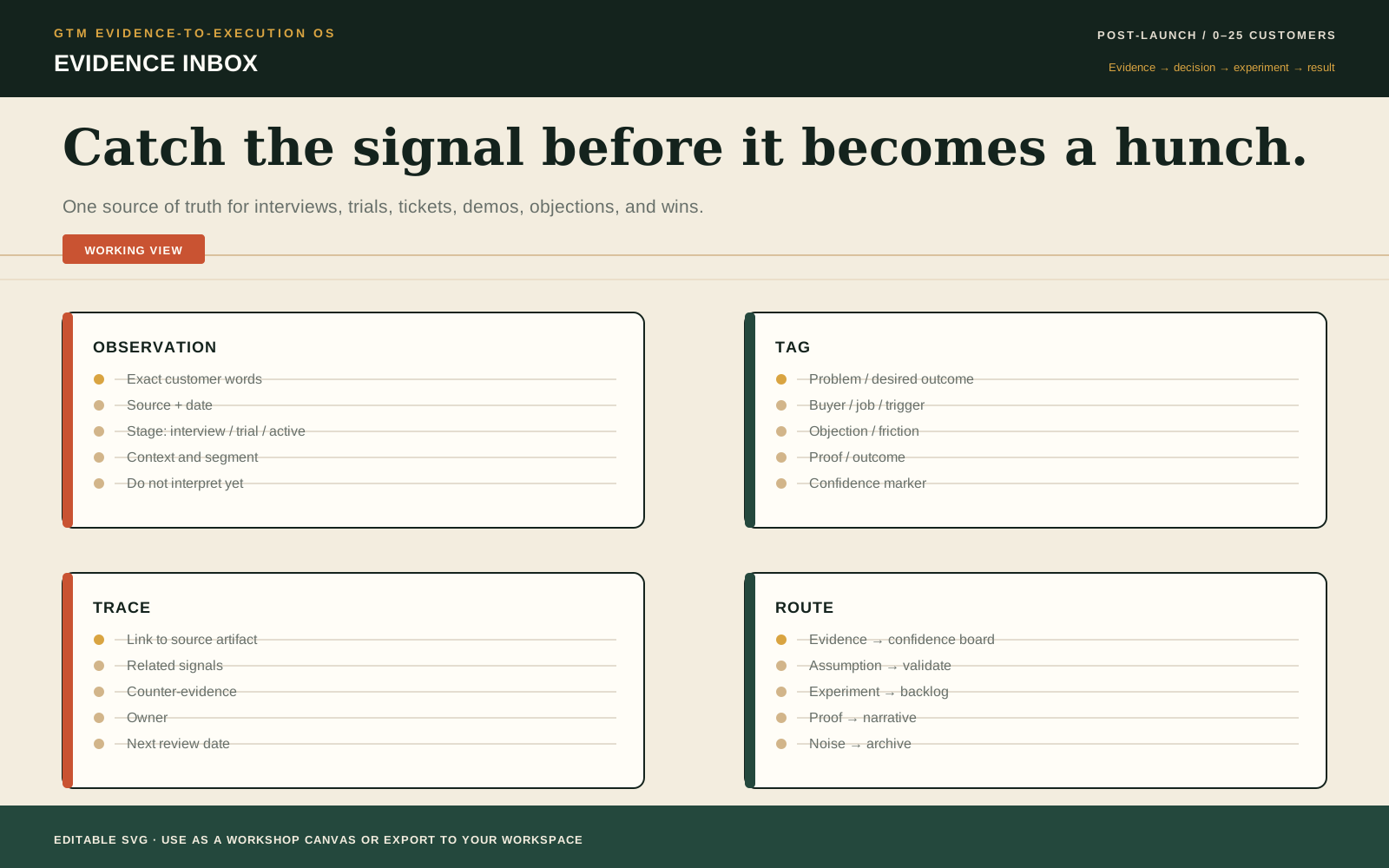
An evidence inbox is the front door of the loop. It should be easy to add a signal in under a few minutes and structured enough that the team can find it later. Keep the initial fields intentionally narrow: date, source, segment, verbatim signal or event, context, suspected theme, confidence, owner, and next review date.
Use sources that reflect the real post-launch experience:
- customer interviews and onboarding calls;
- support requests, implementation questions, and repeated workarounds;
- trial and product-usage events tied to a meaningful action;
- sales objections, lost-deal notes, and questions from qualified buyers;
- customer language from community posts, reviews, or renewal conversations;
- internal observations from delivery, success, or technical teams.
Do not force every source into the same level of certainty. A product event can tell you that something happened, not why. An interview can explain motivation, not how common it is. A sales objection can reveal a buying barrier, not prove that every segment shares it. The inbox is valuable because it preserves these distinctions instead of flattening every input into a single priority score.
For interviews, capture a short story rather than a slogan. “We need better reporting” is a weak record. “On the last Monday of the month, the operations lead exported three screens into a spreadsheet because the team could not share the workspace view with finance” contains a situation, behavior, workaround, and consequence. That record can support a much better next question.
Set a weekly inbox review. The purpose is not to empty the inbox or convert every note into a ticket. It is to cluster related observations, merge duplicates, retire stale assumptions, and select one or two opportunities that deserve a deliberate decision. A small team should leave the review with a clear next experiment or a justified decision to wait.
Turn signals into experiments
An experiment card is the bridge from evidence to action. It should state the assumption, the audience, the smallest responsible test, the expected observation, the instrumentation or collection method, the time box, the stop rule, and the decision that follows. The point is not to make every test statistically conclusive. The point is to make the learning claim precise enough to discuss honestly.
A useful template looks like this:
- Assumption: what do we currently believe about the customer, problem, promise, behavior, or proof point?
- Risk: what would be expensive or misleading if this belief is wrong?
- Test: what is the smallest action that exposes the assumption to real behavior?
- Signal: what will we observe, and what will we not claim from that observation?
- Decision rule: what result would make us continue, change the test, narrow the segment, or stop?
For example, suppose interviews suggest that technical founders understand the product’s feature set but do not understand the first successful outcome. The test might be a revised onboarding path that asks the user to complete one outcome-oriented action before showing secondary configuration. The observation could be completion of that action, time to first value, and a short follow-up conversation. The test does not prove product-market fit. It answers a narrower question about whether the new path makes the intended outcome easier to reach.
Keep discovery tests separate from production commitments when possible. A prototype, guided walkthrough, concierge step, or opt-in customer test can reveal value and usability risk before the team invests in a fully hardened feature. Once the evidence supports a direction, delivery work can proceed with clearer assumptions. This distinction protects both learning speed and product quality.
Protect the proof ledger
Teams often remember the existence of an experiment but lose the chain that made it meaningful. A proof ledger preserves that chain: source evidence, decision, test, result, confidence change, and permission or visibility status. It should be possible to answer, “Why did we believe this, what did we do, and what did we learn?” without reopening six tools.
Permission matters. Customer quotes, screenshots, recordings, account names, and sensitive usage details may not be safe to reuse in a public case study, sales deck, or marketing page. Add a permission field and a handling note. Keep fictional worked examples clearly labelled as fictional. If a signal is confidential, preserve the learning without publishing identifying details.
A proof ledger also makes negative learning useful. “The experiment failed” is too vague. Record what was tested, which audience saw it, what happened, what did not happen, and which assumption is now weaker or more specific. A result can be inconclusive without being wasted if it narrows the next question.
Run a 30-day founder loop
A 30-day cadence gives a solo founder or small team enough structure to build a habit without pretending that every product question can be resolved in four weeks. Use four weekly passes:
- Week one — collect: capture recent interviews, usage signals, objections, support patterns, and customer language. Normalize the records without prematurely ranking them.
- Week two — interpret: cluster related observations, write the suspected opportunity or risk, identify the customer segment, and mark confidence plus missing evidence.
- Week three — test: run one bounded experiment with an explicit signal, time box, instrumentation plan, and stop rule. Keep the test small enough to finish.
- Week four — decide: record the result, update the proof ledger, decide what to continue or stop, and choose the next question. Share the decision in the same place where the evidence lives.
The founder review should be a decision meeting, not a dashboard tour. Ask: What changed? Which evidence is new? Which assumption is still carrying too much risk? What is the smallest next move that can reduce that risk? What will we deliberately not do this week?
Illustrative SaaS example
Illustrative example: A fictional product called Northstar Analytics has a working dashboard and a handful of paying teams. The founder hears three different comments: one user says setup is too technical, a sales prospect asks whether the product can prove value to a finance leader, and usage data shows that teams who invite a second teammate are more likely to return the following week.
The team does not immediately rebuild onboarding, add finance reporting, and redesign collaboration. It stores each signal with its source and context. In the weekly review, it notices that all three may relate to the same broader question: can the product help a team reach and explain a shared outcome quickly?
The next experiment is narrower. For one segment, the onboarding path adds a guided “first proof” step that produces a shareable outcome summary and invites a teammate. The team records completion, invitation, return behavior, and a short follow-up interview. If the test produces a stronger signal, the team may invest in a more durable onboarding and proof surface. If not, it has learned that the assumed bridge between setup, collaboration, and value needs a different explanation.
This example is fictional and does not establish a benchmark or guarantee. Its purpose is to show how a loop prevents three disconnected requests from becoming three disconnected projects.
Implementation checklist
Start with the smallest useful version. Before the next founder review, make sure you can answer these questions:
- Where does a new customer or product signal enter the system?
- Can a reader distinguish observation, context, interpretation, and decision?
- Can you identify the segment and source behind a signal?
- Does every experiment have one assumption, one primary observation, a time box, and a decision rule?
- Where are permission, confidentiality, and reuse status recorded?
- Can the team find the result of the last experiment without searching several tools?
- What is the next review date and who owns the decision?
Do not add fields simply because a mature research team uses them. Add a field when it prevents a recurring mistake. Do not pretend that a confidence score makes uncertainty disappear. Do not call a short experiment a growth guarantee. The value of the system is that it gives a small team a reliable place to see what it knows, what it suspects, and what it will learn next.
A post-launch evidence loop is successful when it changes the quality of the team’s next decision. It helps founders avoid building from the loudest anecdote, helps teams preserve the context behind customer language, and makes small experiments easier to interpret. The GTM Evidence-to-Execution OS packages this operating shape into editable Evidence Inbox, Signal Codebook, Confidence Gate, Experiment Card, Proof Ledger, Weekly Founder Review, 30-Day Map, and Decision Trace boards, plus a workbook and implementation guide. It is a planning system, not a promise of customers, conversion, or revenue.
Evidence consulted
Sources and limits
These sources support the practical principles discussed above. They do not establish one universal client-delivery rule or guarantee a project outcome.
- Silicon Valley Product Group — The Product Operating Model: discovery evidence, outcomes, and rapid experimentation
- Silicon Valley Product Group — Discovery vs. Delivery: learn quickly without lowering production quality
- Product Talk — Customer Interviews: specific past behavior, interview snapshots, and actionable synthesis
- GTM Evidence-to-Execution OS — live product listing and package scope
Useful answers
Frequently asked questions
What is a SaaS post-launch evidence loop?
It is a repeatable way to capture customer and product signals, preserve context, choose one decision to investigate, run a bounded experiment, and record what changed. It helps a team move from scattered evidence to an inspectable next move without treating every signal as a roadmap commitment.
What evidence should a SaaS founder collect after launch?
Collect specific customer stories, support patterns, onboarding friction, meaningful product-usage events, sales objections, lost-deal reasons, renewal conversations, and customer language. Label the source and context because each kind of evidence answers a different question.
How is an evidence loop different from a product backlog?
A backlog stores possible work. An evidence loop stores why a decision might matter, what is known, what is uncertain, what test will reduce risk, and what happened afterward. The loop can produce backlog items, but it should not turn every observation into a feature request.
How long should a post-launch experiment run?
Use the smallest responsible time box that can expose the assumption to meaningful behavior. Some tests may take a day and others several weeks. State the observation and decision rule before the test so you do not extend it indefinitely to obtain a preferred result.
Can a founder use an evidence loop without a data team?
Yes. A small team can begin with an evidence inbox, a weekly review, one experiment card, and a proof ledger. Start with interviews, support notes, sales conversations, and a few trustworthy product events; add complexity only when it prevents a recurring decision error.