When a studio has one or two projects, delivery can run on memory, messages, and a founder’s daily scan of what feels urgent. At three to ten active projects, that informal system starts to hide the same problems: a client decision is late, a designer is waiting on an answer, two deadlines depend on the same person, or a small request quietly becomes a second round of work.
Studio delivery operations is the practice of making those dependencies visible and giving the team a repeatable way to decide what happens next. It is not a demand for enterprise bureaucracy. It is a small operating system for work already in motion.
The Association for Project Management describes project controls as preparing work, anticipating what might go wrong, measuring progress objectively, forecasting what may happen, and taking corrective action. Its core areas include time, cost, risk, change, reporting, information, and communication. A studio can apply the same logic with a few clear fields and recurring conversations rather than a large controls department. APM’s overview of project controls is a useful reference for the underlying discipline.
Why a delivery rhythm matters at 3–10 projects
A delivery rhythm answers four operational questions every week:
- Which projects are moving, waiting, or at risk?
- What is the next decision, and who owns it?
- What work is competing for the same scarce person or time window?
- What must be approved, changed, or escalated before more production begins?
The rhythm is more important than the software. A board can show tasks without making decisions clear, and a polished dashboard can still leave a team guessing about whether a client has approved the latest direction. The minimum useful system connects status to an action: “waiting for copy from client,” “studio lead to choose route B,” or “change request needs a time and fee decision.”
Keep the operating rhythm separate from the client-approval process. The approval process defines how a client reviews and accepts work; the studio rhythm defines how the team notices that a review is late, protects the next production slot, and decides whether to remind, replan, or pause. For the approval mechanics themselves, see the related guide to the client approval process.
Build one portfolio view before adding meetings
Start with one row per active project. The view should be readable in a few minutes and answer what a studio lead would otherwise ask in a series of private messages. Use a stable set of fields:
- Project and client: the identifying label used by the team.
- Stage: intake, brief, production, client review, approval, handoff, or follow-up.
- Next decision: the single decision that unlocks the next meaningful piece of work.
- Decision owner: the person who can make or obtain that decision.
- Next date: the date by which the decision or deliverable matters, not merely the date of the next meeting.
- Health: on track, watch, or blocked, with one sentence of explanation.
- Dependency: the person, input, approval, or external event that could change the plan.
Do not turn health into a subjective mood score. “Watch: client review is two business days late and the production slot is Friday” is more actionable than “amber.” If a project is on track, record the next milestone and leave it alone. The portfolio view should help the studio focus attention, not create a reporting task for its own sake.
A useful rule is one next decision per project. If the row contains six priorities, it is not a control view; it is an unfiltered task dump. Detailed production tasks can live elsewhere. The portfolio layer exists to coordinate projects against each other.
Run a weekly studio delivery review
Choose a fixed weekly time and keep the review short enough that it can survive a busy delivery week. The meeting is for decisions and exceptions, not for reading every task aloud. A practical agenda has five passes:
- Scan the portfolio: look for blocked, overdue, or newly changed projects.
- Confirm the next decision: make sure each watch or blocked item has a named owner and a date.
- Check cross-project capacity: compare upcoming review, production, and handoff demand against the people who must perform it.
- Resolve exceptions: choose a recovery action, replan a date, request a client decision, or escalate a decision outside the team’s authority.
- Publish the update: record decisions and changed dates in the shared view so the team is not relying on meeting memory.
Keep the agenda distinct from a general status meeting. A status meeting can describe what happened; a delivery review should decide what happens next. If no decision is needed, the item can remain visible without consuming discussion time.
Use a weekly review to manage the portfolio, not to micromanage specialists. A creative lead may need autonomy over how work is made while the studio still needs clarity on the promised milestone, the approval state, and the capacity trade-off. The review should ask, “What decision or constraint needs attention?” rather than, “Why did every task take this long?”
Give each project a simple working cadence
The portfolio review is not enough. Each project needs a predictable handoff between internal production and client-facing decisions. The exact cadence depends on the work, but most studios can make four moments explicit:
Brief lock
Before meaningful production starts, confirm the objective, audience, deliverables, inputs, decision-makers, and acceptance signals. A brief lock does not mean every creative detail is known. It means the team knows what is being solved and what would count as a valid decision. If the brief is still moving, label the project as shaping rather than pretending production has begun.
Production checkpoint
Use a short internal checkpoint to compare work in progress with the agreed direction. Look for missing inputs, quality risks, and decisions that should be made before more effort accumulates. This is the right moment to narrow options or ask for a lead’s decision, not after a full round has been polished.
Client review and approval gate
Send work for review with a clear request: what should the client review, by when, and what form should feedback take? When feedback arrives, classify it as an approval, a revision within the agreed direction, a new decision, or a possible change to scope. Do not let a review message silently become a new baseline.
Handoff and closeout
Handoff is a delivery event, not an administrative afterthought. Confirm the files, access, usage notes, open items, and owner for any remaining action. Then close the project in the portfolio view and capture a brief learning note: what should the studio repeat, clarify, or price differently next time?
This cadence complements, rather than duplicates, a change-order article. The scope-creep and change-order guide can cover how to respond when a request changes the agreed work; this article focuses on where that decision sits inside the studio’s weekly operating rhythm.
Use approval and change gates to protect flow
A gate is a decision point that prevents the next kind of work from starting by accident. Keep gates few and visible. For a small studio, brief lock, client approval, change decision, and handoff are usually enough.
At each gate, record four things: the decision, the decision-maker, the date, and the consequence. “Approved direction B by client on Tuesday; production may continue” is stronger than “client liked it.” “Revision request accepted within current scope; Friday milestone unchanged” is stronger than “minor changes.” This language gives the team a shared interpretation of what the message means.
When a request may change the baseline, use a small change log. Capture the request, why it matters, affected deliverables, impact on time or capacity, and the decision. APM defines change control as capturing, evaluating, and then approving, rejecting, or deferring requests to change an approved baseline. Its suggested evaluation considers scope, quality, time, resources, cost, risk, and stakeholder engagement. A studio does not need a formal board for every request, but it does need the same decision logic at an appropriate scale. See APM’s change-control guidance for the full framing.
Use a simple threshold. A request can stay within the current plan when it does not alter the agreed deliverable, required effort, review rounds, or milestone. It needs a decision when it adds work, changes the direction, consumes a reserved production slot, introduces a new approver, or moves a committed date. The response may be to absorb it, trade it for something else, replan, or price it separately. The important point is that the trade-off is explicit.
Make capacity and escalation visible
Capacity planning for a small studio is less about forecasting every hour and more about seeing collisions early. Review the next two or three weeks for concentrated demand: several client reviews on the same day, one specialist needed by multiple projects, or handoffs that all depend on the studio lead.
Track commitments at the level that changes a decision. “Designer needed for two review rounds next week” may be enough. If the plan is already full, do not hide the conflict by giving every project the same status. Choose which milestone moves, which work is narrowed, who can help, or which new work cannot start yet.
Define escalation as a route, not a mood. A project moves up for a decision when the team cannot resolve a blocked dependency, a tolerance is exceeded, a client decision threatens another commitment, or the request changes scope, quality, time, cost, or risk. APM describes governance as the framework of authority and accountability that controls project outputs, outcomes, and benefits; it also emphasizes delegated limits of authority and escalation routes. The APM governance overview is relevant even for a small team because clear authority prevents every question from reaching the founder.
The UK Government’s GovS 002 project-delivery standard is written for government, not creative studios, but its structure is a useful professional reference: governance and roles, planning and control, change control, risk and issue management, reporting, decision-making, and resource capacity are treated as connected practices. A studio can scale the formality down without losing the logic. Read the Government Functional Standard GovS 002 for the broader model.
Illustrative example: a six-project studio
Illustrative example. Imagine a six-person studio with six active projects: a brand identity in production, a website in client review, two content packages awaiting inputs, a campaign about to start, and a completed project in handoff. The weekly portfolio review finds that both the website and campaign need the same strategist on Thursday, while the content packages have no confirmed client decision-maker.
The studio does not respond by asking everyone to work faster. It records the collisions. The campaign’s internal checkpoint moves to Wednesday, the website review request is clarified with one named client approver, and one content package is marked watch until its input owner confirms a date. The completed project gets a handoff owner and a closeout date. No project is “red” merely because it feels busy; each exception has a decision and a next action.
In the following review, the studio can see whether those actions worked. If the same collision appears repeatedly, the issue may be a scheduling rule, a promise made during sales, or a missing role—not a one-off capacity problem. This is how a rhythm creates learning without requiring a large operations function.
Keep the system useful as the studio grows
Start with the smallest shared view that changes behavior. If the team will not update ten fields, choose five: stage, next decision, owner, date, and health. Add detail only when it answers a recurring question or prevents a recurring failure.
Give every field an owner and a refresh expectation. The person closest to a project can update its working status; the studio lead can own the portfolio review and capacity decisions. Avoid making one operations-minded person the only source of truth. A system that depends on a single memory keeper will fail when that person is unavailable.
Review the rhythm monthly. Keep the meeting if it produces decisions, removes blockers, or exposes capacity trade-offs. Shorten or remove any step that only produces a report nobody uses. Add a new gate only after a real failure shows that an important decision is repeatedly being made too late.
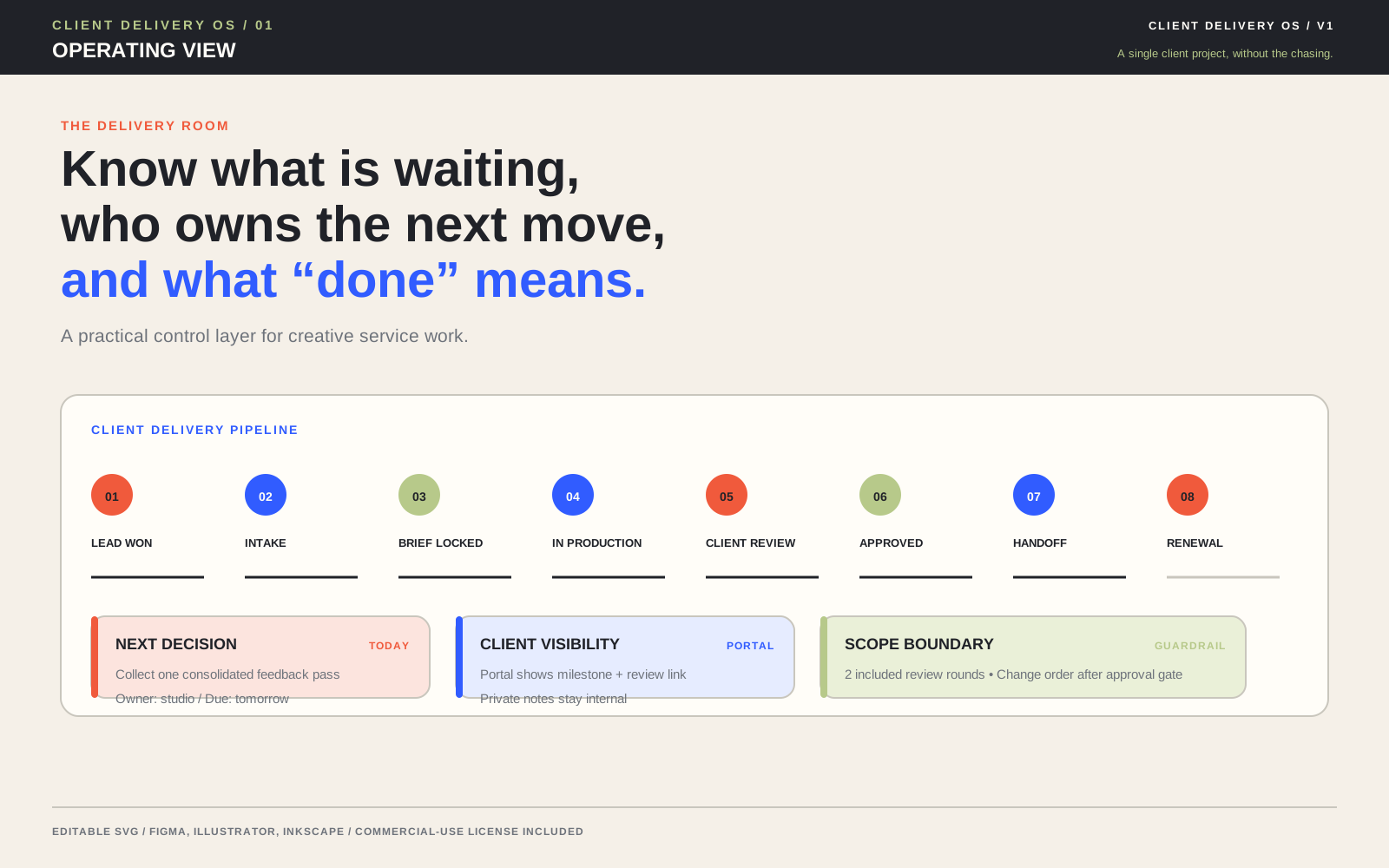
A delivery framework or template can accelerate setup, but it does not replace judgment. Client Delivery OS is positioned as a planning and workflow framework for freelance designers, developers, and small creative studios managing 3–10 active client projects. Its listed materials include operating views for intake, brief lock, production, feedback, approval, change order, milestones, handoff, renewal follow-up, and a studio snapshot, plus CSV tables, a Notion setup map, copy, and a guide. Treat those as configurable starting points, replace sample data, and adapt the fields to the studio’s actual authority and client commitments.
The durable outcome is not a perfect board. It is a shared habit: see the portfolio, name the next decision, protect the next commitment, and record the trade-off before work moves on.
Evidence consulted
Sources and limits
These sources support the practical principles discussed above. They do not establish one universal client-delivery rule or guarantee a project outcome.
- Association for Project Management: What is project controls?
- Association for Project Management: What is change control?
- Association for Project Management: What is governance?
- UK Government Project Delivery: Government Functional Standard GovS 002
- Project Management Institute: Project governance—critical success factor
Useful answers
Frequently asked questions
What is a delivery operating rhythm for a small creative studio?
It is a repeatable set of portfolio reviews, project checkpoints, approval gates, and escalation rules that helps a studio see what is moving, what is waiting, and what decision comes next across 3–10 active projects.
How often should a studio review its active projects?
A weekly portfolio review is a practical default for 3–10 active projects. Keep it focused on blocked work, upcoming decisions, cross-project capacity, exceptions, and recording changed dates rather than reading every task aloud.
What fields should a multi-project studio track?
Track each project’s stage, next decision, decision owner, next important date, health, and key dependency. These fields connect project status to an action without requiring a large reporting system.
When should a client request go through change control?
Use change control when a request may alter the agreed deliverable, effort, review rounds, production slot, approver, or committed date. Record the request, assess its impact, and explicitly absorb, trade, replan, approve separately, reject, or defer it.
Does a small studio need a project management office to manage 3–10 projects?
No. A studio can scale professional project-control ideas down to a shared portfolio view, a weekly decision review, clear authority, simple change logging, and a few delivery gates. The aim is visibility and timely decisions, not enterprise bureaucracy.