Client approval should be a decision point, not an endless conversation. A useful client approval process tells everyone what is ready for review, who can decide, what counts as approval, and what happens after the decision. It gives the client enough context to respond confidently while protecting the freelancer or studio from scattered comments, silent delays, and unpriced work.
The aim is not to add bureaucracy. It is to make the next decision obvious. A small studio can run a strong approval process with a brief, a review link or delivery space, one feedback record, and a written approval message. The system should be light enough to use on every milestone.
What a client approval process does
An approval process separates four activities that are often mixed together: presenting work, reviewing work, requesting a correction, and authorizing the next stage. When these activities happen in one chat thread, a casual preference can look like a requirement, and a new idea can quietly become an obligation.
Approval is also different from feedback consolidation. Consolidation answers, What does the client want changed? Approval answers, Is the agreed work accepted so we can proceed? If you need a system for merging comments from several reviewers before a decision, see how to consolidate client feedback. This article focuses on the gate that follows that review.
Use an approval gate at a meaningful boundary: a locked brief, a selected direction, a completed design round, a staging review, or a final handoff. Do not ask for formal approval for every tiny internal task. Too many gates slow the project and encourage clients to treat each gate as another open-ended ideation session.
Design the approval gate
A gate needs five visible parts. First, name the item being approved, such as the homepage design or the tested staging build. Second, state the decision that approval unlocks, such as production implementation or final packaging. Third, list the acceptance criteria in plain language. Fourth, identify the approver and the response date. Fifth, state the boundary: comments that alter the agreed deliverable will be assessed as a change.
Write acceptance criteria before sending the work. A designer might specify the approved direction, page count, content supplied by the client, and brand requirements. A developer might specify supported browsers, documented integrations, agreed user flows, and test conditions. Criteria do not need to predict every detail. They need to make completion observable enough that a reviewer can say yes, no, or not yet for a reason.
Give the client one decision route. A shared review page, a project record, or a single email thread can work. The channel matters less than the rule that the current version and the final decision live together. Avoid asking for approval in a direct message while storing the deliverable somewhere else.
A seven-step client approval process
The following process is intentionally lean. Adapt the response window and level of detail to the project, but keep the order stable.
- Define the gate, the deliverable under review, the approver, the response date, and the decision that approval will unlock.
- Send a review package that contains the current version, acceptance criteria, known limitations, and one clear instruction for how to respond.
- Collect all reviewer comments in one place and ask the client lead to reconcile conflicting internal opinions before you act on them.
- Classify each comment as a correction to the agreed work, a clarification, a preference, or a request that changes scope, timing, or effort.
- Respond with a short decision record that states what will be addressed, what is accepted as-is, and what needs a change-order conversation.
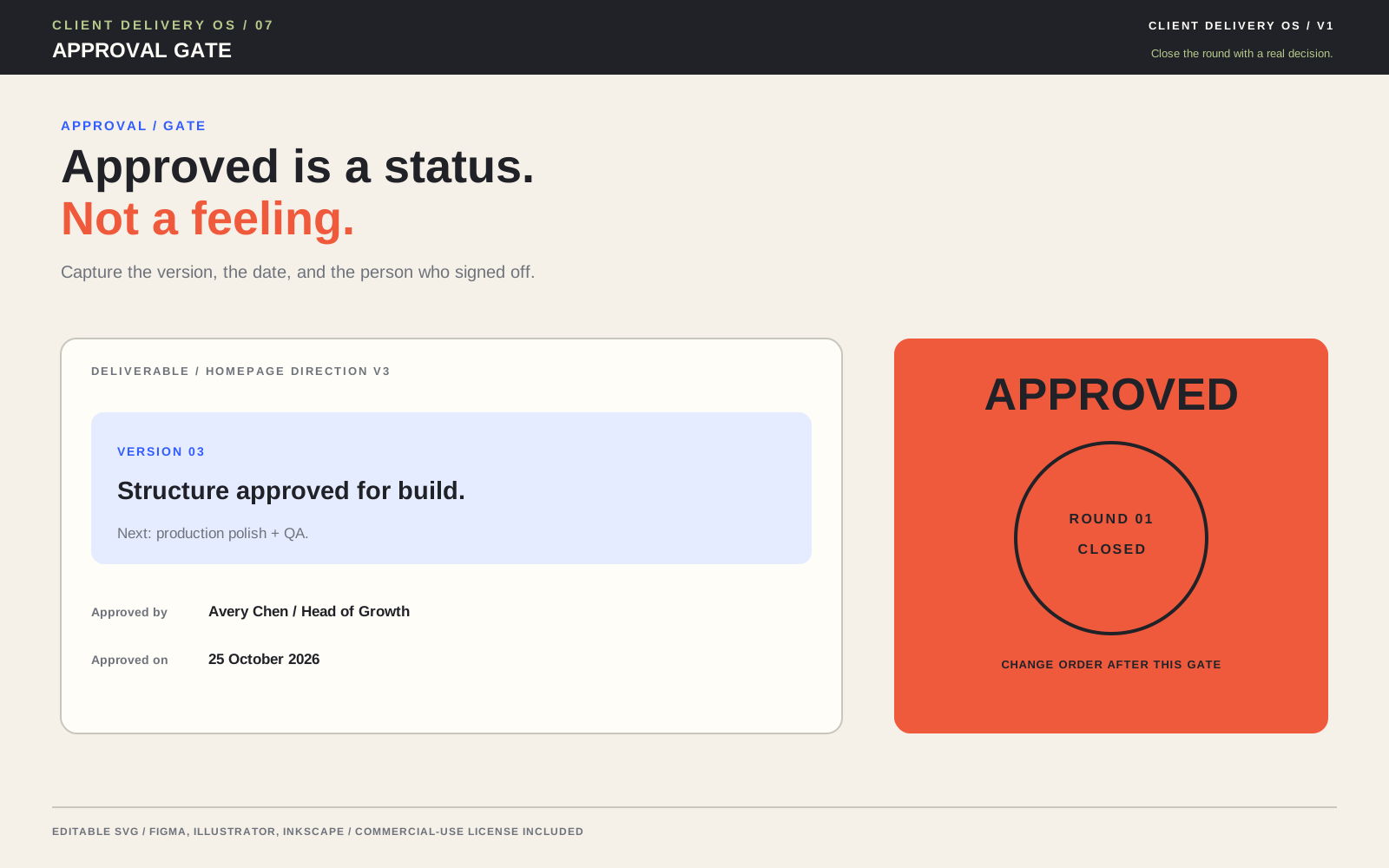
- Obtain written approval from the named approver and record the approved version, date, and any conditions attached to the decision.
- Move the approved work to the next stage and reopen the gate only when a documented exception or approved change requires it.
The process works because it creates a clean handoff between review and production. Do not start the next stage based on a message such as looks good if the project has several stakeholders or the comment could reasonably mean proceed with changes. Ask for a direct decision when ambiguity would create rework.
Set decision rights before review
Ask the client to nominate one person who can consolidate internal feedback and one person, if different, who can give final approval. On a small project, that may be the same person. If several people can independently approve, explain how conflicting decisions will be resolved. You can still welcome specialist input, but the project needs one accountable decision.
Your own decision rights should be equally clear. You can usually resolve a typo, implementation defect, or missed agreed requirement without treating it as new scope. You should not unilaterally reinterpret a new deliverable, extra page, new integration, or material change in direction as a correction.
Make feedback reviewable
Good feedback is specific enough to act on. Ask reviewers to identify the location, describe the issue, explain the desired outcome, and label urgency when urgency genuinely matters. A comment such as make it feel more premium is a discussion prompt, not an executable acceptance criterion. Turn it into a decision by asking which agreed objective is not being met and what observable change would address it.
Keep the review package small. Show the version under review, what changed since the last gate, and what the reviewer must decide now. Do not bury the decision in a long progress update. If there are multiple files, designate one source of truth and mark older versions as superseded.
Set a feedback deadline as a planning input, not as a threat. Explain what happens if the deadline passes: the schedule may move, reserved production time may be released, or the next milestone may be re-planned. A client delay clause belongs in the agreement and should be applied consistently. AIGA’s guidance on proposals recommends spelling out phases, milestones, deliverables, revisions, client responsibilities, and how the client participates in the process.
When several reviewers comment, do not become the referee for an unresolved internal debate. Ask the client lead to consolidate the position. This preserves your role as the person executing an agreed decision rather than making an unpriced judgment about which stakeholder wins.
Decide when a request is a change
Use the original scope as the reference point. A request is normally a correction when the delivered work fails an agreed requirement or contains an error. It is more likely to be a change when it adds a deliverable, introduces a new audience or use case, alters a locked direction, adds an integration, expands the number of variants, or changes the timeline.
There is a practical middle ground between accepting every request and rejecting every request. A small wording adjustment may fit inside an included revision round. A new page may be valuable but still require more design, content, development, testing, or coordination. Explain the difference without blame: the request is reasonable, but it is not covered by the current approval gate.
For an out-of-scope request, record the requested outcome, the effect on deliverables, the estimated effort or fee basis, the schedule effect, and the decision needed. Do not begin the added work while approval is pending unless both parties explicitly agree to that risk. For a deeper treatment of boundaries and approvals for added work, link to scope creep and change orders.
Keep the change path proportionate. A one-line copy adjustment can be handled in a brief written note if the contract permits it. A new feature or material redesign deserves a short change order or amended scope. PMI’s scope-control guidance emphasizes defining the baseline, assessing the impact of a proposed change, obtaining documented approval, and updating the plan. It also warns that excessive administration can cause people to bypass the process.
Illustrative example
Illustrative example: A small studio sends a homepage concept for approval. The gate says the client is approving one selected visual direction, desktop and mobile layouts, and the agreed content structure. The client lead replies with three corrections: the logo is too small, the button label does not match the supplied copy, and the mobile navigation does not meet the agreed behavior. Those are corrections because they refer to the agreed work.
The same reply also asks for a new campaign landing page and a second mobile interaction for a different audience. Those requests may be worthwhile, but they change the deliverable set. The studio records them as a proposed change, explains the added effort and schedule effect, and keeps the homepage gate open only for the original corrections. The client can approve the corrected homepage while separately deciding whether to authorize the landing page.
This split prevents a common failure mode: holding an entire milestone hostage to new ideas while the original work is ready to move forward. It also avoids treating a new request as a rejection of work that already satisfies the agreed criteria.
Use acceptance criteria for quality
Acceptance criteria should cover the qualities that matter to the deliverable, not just whether the client likes the visual polish. For a website, include agreed content, responsive behavior, key user flows, links, forms, performance assumptions, and accessibility requirements that are in scope. For a brand asset, include file formats, color specifications, usage contexts, and the approved direction. For a development milestone, include the tested behavior, environment, data assumptions, and known exclusions.
If accessibility is part of the project, make it reviewable rather than aspirational. The W3C WCAG 2.2 quick reference organizes success criteria by level and provides testable criteria and techniques. Choose the applicable requirements with the client and document what was reviewed. Do not claim compliance with a standard unless the project has actually been evaluated against the relevant requirements.
Quality criteria also protect the client. They give reviewers a fair way to identify a real miss without relying on taste alone. ISO’s explanation of quality management connects consistent delivery with customer focus, a process approach, documented information, measurement, and continual improvement. A lightweight approval record is one way to make those principles useful in a small creative practice.
Approval process checklist
Before sending a gate, check that the deliverable is named, the current version is clear, and the acceptance criteria are written. Confirm that the approver knows what decision is needed and that the response route is singular. After review, consolidate comments, separate corrections from changes, and record the decision in plain language.
At approval, save the date, approver, version, conditions, and next stage. If approval is conditional, list the conditions and who owns each action. If approval is withheld, ask which acceptance criterion is not met and what evidence would resolve the issue. If the request is new scope, pause, price or estimate it fairly, and get authorization before doing the added work.
A client approval process succeeds when it creates momentum without hiding trade-offs. The client gets a clear chance to review the work, and the freelancer gets a reliable record of what was accepted. That is the difference between being endlessly available for comments and running a delivery system that can move from one decision to the next.
Evidence consulted
Sources and limits
These sources support the practical principles discussed above. They do not establish one universal client-delivery rule or guarantee a project outcome.
- AIGA guidance on proposals, scope, milestones, client responsibilities, revisions, change orders, and client delays
- PMI guidance on scope definition, documented approvals, impact analysis, and change control
- ISO explanation of quality management, customer focus, process approach, documented information, and continual improvement
- W3C WCAG 2.2 quick reference for testable accessibility success criteria
- Live Client Delivery OS product page used to verify product facts
Useful answers
Frequently asked questions
What should a client approval process include?
It should identify the deliverable under review, the acceptance criteria, the person who can approve, the response date, the feedback route, and the decision that approval unlocks. It should also explain how requests that change scope, timing, or effort will be handled.
How do I stop feedback from coming from too many people?
Ask the client to appoint one lead who consolidates internal comments and one accountable approver. Other stakeholders can contribute specialist input, but the client lead should reconcile conflicts before the studio acts on them.
Is a client revision request always a scope change?
No. A correction to an agreed requirement or an included revision can remain inside the current scope. A new deliverable, new audience, additional integration, material direction change, or schedule-expanding request is more likely to need a documented change decision.
What counts as written client approval?
A clear message from the named approver that identifies the version or deliverable and says it is approved is usually a practical record. Save the date, version, conditions, and next stage with the project documentation, subject to the terms of the agreement.
How can a freelancer keep approvals from slowing a project?
Use meaningful gates rather than approving every small task, set acceptance criteria before review, provide one source of truth, give a clear response window, and separate corrections from new requests. Keep the change path lean so stakeholders have little reason to bypass it.