What a SaaS cold email sequence should—and should not—do
A sequence is a small set of planned messages and decision rules for one buyer context. It is not a license to send the same pitch repeatedly. The useful unit is not “touch three on day seven.” It is a reasoned next step: what changed, what the recipient might need, and what evidence justifies another message.
For an early-stage SaaS team, the sequence should connect five things: a narrow buyer role, a real company-level signal, an offer the product can actually fulfill, a human-reviewed message, and a respectful route for every kind of response. The workflow should also make it easy to stop when the signal is stale, the fit is poor, the recipient says no, or you have nothing new to add.
Choose one ICP and one offer before writing copy
Start with a specific ideal-customer profile (ICP), not “any SaaS company.” Write down the segment, company stage or operating context, buyer role, workflow problem, and one disqualifier. A founder selling implementation software might focus on B2B SaaS teams that recently introduced a second product integration and have a small solutions team. That is still a hypothesis; it is not proof that every company with an integration needs help.
Then state the offer in one sentence: who it helps, with what task, and what the prospect receives. If the offer is a product demo, say what the demo will show. If it is a short diagnostic, name the output and its limits. Do not use a promise such as “cut onboarding time by 40%” unless you have evidence that supports the exact claim, population, and conditions.
Separate confirmed facts from assumptions. For example: “The company announced a new public integration” may be verifiable; “the implementation team is overwhelmed” is an inference. A good message can say that the signal may matter to a particular workflow and ask whether it is relevant. It should not present the inference as inside knowledge.
Verify one current business signal, its source, and its age
A signal is a public event or product change that gives you a plausible “why now.” Examples can include a product launch, a newly documented integration, a public hiring plan for a directly related function, a published migration guide, or an expansion into a market your offer addresses. Use the minimum information necessary to explain business relevance.
Keep a short evidence record: the company, exact observation, source URL, date you checked it, what it does and does not establish, and your reason for contacting this role. A public announcement can verify that an announcement exists. It does not verify an internal pain, budget, purchase plan, or decision deadline. Treat those as unknown until the company or recipient confirms them.
Reject a signal that cannot be checked, is too old to matter, concerns a different company, or depends on sensitive personal details. Do not fabricate a trigger or imply that a recipient viewed a private page. If the source is an employee’s social post, ask whether that personal information is necessary at all; for this founder-sized workflow, a public company-level fact is usually enough.
Fictional example: “Harborloop published a new integration guide on 3 November” is a bounded observation. “Harborloop’s onboarding team is behind” is not supported by that public guide. The sample preview later in this article uses fictional company and message data.
Map the signal to the buyer’s work without pretending to know their priorities
Before drafting, connect the public event to a task that the chosen role is plausibly responsible for. Write the link as a hypothesis: “If the new integration increases the number of handoffs between product and implementation, this role may care about a clear owner and escalation route.” Then ask whether your product genuinely helps with that task. If you cannot explain the connection in plain language, do not send the pitch.
A useful relevance card has four fields: what is verified, what work may be affected, what your offer can help with, and what remains unknown. Keep the first field factual and the next two modest. The last field prevents the draft from acquiring invented certainty as it moves between a founder, a reviewer, and a sales tool.
Compare a weak opener—“I noticed you’re scaling fast”—with a more grounded one: “Your team published an integration guide this week; teams adding a new integration sometimes need to clarify who owns the handoff.” The second version still needs review: is the observation current, is the role appropriate, and can the sender explain the service without implying the recipient has a problem?
Write a first note that is specific, short, and easy to correct
Use a plain structure rather than a rigid swipe file: name the verified context, explain the possible relevance, describe one accurate offer, and ask one small question. The exact wording depends on the audience, the strength of the signal, and the sender’s relationship with the company. Keep the request proportional to the context; a cold message should not assume a meeting is the only acceptable next step.
Fictional example—not a performance-tested template:
Subject: the new integration guide
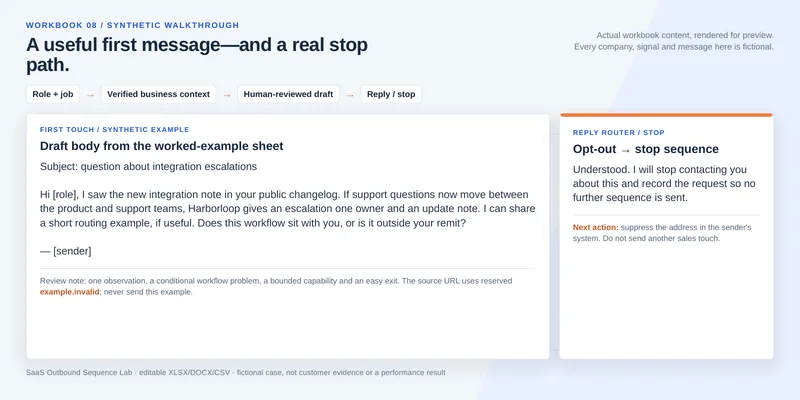
Hi [role], I saw Harborloop’s public integration guide dated 3 November. When a new integration adds a handoff between product and implementation, teams sometimes need a clearer owner for the first customer setup. We help small SaaS teams map that route in a short working session. Is that a workflow you are reviewing, or is it already covered?
Every named company, date, role, offer, and message in this example is fictional. The text is not a claim about a real recipient or a promise that this wording works. Replace the example only with facts you have personally verified and an offer your team can deliver. Remove any sentence that sounds specific but cannot be traced to a source.
Follow up only when you have something new to say
Search results and vendor guides often prescribe a fixed number of touches or a standard number of days between them. Those are starting points published in particular contexts, not a universal schedule for every segment, offer, sender, or jurisdiction. A fixed cadence can turn a relevant first note into repeated interruption if later messages add no new information.
Before a follow-up, answer three questions: Is the original business signal still current? Can I add a useful detail, example, correction, or resource that was not in the prior note? Is another message appropriate under our approved sending rules and recipient preferences? If the answer to the second question is no, do not send a filler “checking in.” A pause can be the correct next action.
A follow-up may clarify one point, share a short guide that directly matches the signal, or ask whether the timing has changed. It should not repeat the full pitch, stack multiple links, or imply that silence is consent. If the recipient asks for later contact, record the requested timing accurately and review it against the sender’s process. If they say no or ask not to be contacted, stop rather than routing them to another sequence.
Some benchmark reports observe replies on later steps. That observation does not establish that a particular message count or interval caused the replies. Keep your own review tied to the audience, offer, and step that produced it.
Route replies, wrong fits, opt-outs, and silence explicitly
A plan is incomplete if it only describes what to send. Define what happens after a response so a positive reply, a correction, and a clear stop request do not all land in the same “interested” bucket. Keep the route proportional: assign an owner, record the minimum needed context, and prevent further automated contact where your approved process requires it.
- Interested or curious: reply to the question asked, confirm the next step, and avoid assuming they are ready to buy.
- Not now: record the stated timing or close the loop; do not manufacture a follow-up date the person did not request.
- Wrong role or company: thank them, correct the record, and ask for a referral only when it is appropriate and low-pressure.
- Clear no or opt-out: stop the sequence and apply the sender’s suppression process before any later campaign.
- No response: follow the pre-approved end rule; silence is not evidence of intent, permission, or product fit.
These are operating routes, not legal instructions. The kit’s reply-pattern examples are prompts for human review, not automatically approved replies. Adapt them to your organization’s policies, provider controls, and qualified guidance. Do not reword an opt-out into an objection-handling opportunity.
Measure learning without turning a small sample into a promise
Decide what counts as a useful outcome before launch. A positive reply, an explicit referral, a request to revisit later, a wrong-role correction, and an opt-out are different observations. Track them separately. For a small test, a few events can move a percentage sharply, so show counts alongside rates and state the denominator.
Review the signal source, ICP fit, offer, message and response route together. A low response could reflect poor targeting, stale signals, an unclear offer, timing, mail-provider filtering, or simple sampling variation. An enthusiastic reply may reflect a one-off need, not broad demand. Change one major assumption at a time where practical and retain a short note about what changed.
Instantly’s 2026 benchmark reports data from platform workspaces over a defined 2025 period, including replies across first and later touches. Lavender’s benchmark describes emails from inboxes connected to its own coaching product. Both are useful context for how vendors report activity, but both are observational, vendor-selected samples rather than a forecast for your campaign. The same vendor reports caution that audience and offer matter. Do not transfer a reported average to your startup or use a benchmark as a sales claim.
Check technical sender guidance at the provider, not in an old template
Message copy is only one part of an outbound system. Email providers maintain their own technical guidance on authentication, complaint rates, unsubscribe handling, and delivery requirements. Google’s published sender guidance is specific to sending to personal Gmail accounts and distinguishes baseline authentication from requirements for bulk senders. Yahoo’s Sender Hub describes its own authentication and complaint/unsubscribe expectations. Recheck each provider’s current material at the time you configure a sending system.
These platform documents are not a complete statement of the laws that may apply to your location, recipients, message type, or business. They are also not deliverability guarantees. This article and the product do not interpret legal rules, give permission to contact anyone, certify compliance, recommend a volume threshold, or teach ways to bypass filters. Get qualified advice for your situation and follow your organization’s approved data, contact, and opt-out process.
Keep this check separate from personalization. A warm-sounding message does not make an unverified contact appropriate, and correct authentication does not make irrelevant copy useful. Both the human relevance review and the technical setup need their own owners.
Build the smallest responsible sequence in five steps
Use a short review loop to turn the idea into an inspectable plan. The point is not to fill every row or force a send. It is to make the assumptions, evidence, and stop conditions visible to whoever approves the work.
- Choose one ICP and one offer. Name the company context, buyer role, workflow problem, disqualifier, and one deliverable your team can truthfully provide.
- Log and verify one company-level signal. Save the source URL, date checked, exact observation, confidence, and what remains unknown; reject stale or unverifiable details.
- Draft one human-reviewed first note. Connect the verified context to a plausible job-to-be-done, make one bounded offer, and use one easy-to-correct question.
- Plan conditional follow-ups and reply routes. Send only when a new useful detail exists; define the no-response end, wrong-role correction, requested-later route, and stop on a clear no or opt-out.
- Review counts, context, and the next decision. Compare outcomes by segment and step, show denominators, update one assumption, and pause if the evidence or relevance is weak.
Revisit the plan when the company context changes or a recipient supplies better information. A sequence should be easy to retire. If the plan only works when a stale signal is treated as urgent, or when an opt-out is ignored, it is not a useful sequence.
Where the SaaS Outbound Sequence Lab helps—and where it stops
The SaaS Outbound Sequence Lab — One ICP to One Sequence is a $39 planning and drafting package for early-stage B2B SaaS founders and first SDRs. Its editable nine-sheet workbook connects an ICP, one company signal, an offer, message patterns, reply routes, review notes, and a clearly synthetic worked example. The ZIP also includes four CSV templates, an editable field guide and message-pattern library in DOCX, reading PDFs, source notes, and a single-team license.
The preview shows the product’s synthetic workbook example: its company, role, signal, and draft are fictional. It is a planning workbook, not a tool for finding or emailing prospects.
If you want to move from a market observation to a product experiment after talking to prospects, the separate SaaS post-launch evidence loop covers that next decision. If your question is what users do after entering the product, the SaaS activation audit owns onboarding and first-value work. These guides are adjacent to prospecting, not substitutes for this sequence-planning workflow.
Use the fieldbook when you need a consistent planning surface and editable examples. Skip it if you need sending software, a lead database, legal advice, or promised campaign performance. Verify every factual statement before use, follow your own permissions and sender policies, and keep a person responsible for the final decision.
Evidence consulted
Sources and limits
These sources support the practical principles discussed above. They do not establish one universal operating rule or guarantee a product outcome.
Useful answers
Frequently asked questions
What is a SaaS cold email sequence?
It is a planned set of individualized business outreach messages and decision rules for one buyer context. A useful sequence connects a verified company-level signal, a relevant role, an accurate offer, human review, and clear response and stop routes. It is not an instruction to repeat the same message on a fixed schedule.
How many emails should a SaaS cold email sequence contain?
There is no universal number that fits every audience, signal, offer, and sender policy. Start with the smallest plan that can add useful context, define an end rule, and review outcomes by step with counts and denominators. If a follow-up adds nothing new, pause rather than send a filler touch.
What should the first SaaS cold email include?
Use one current, verifiable business context, a modest explanation of why it may relate to the recipient’s work, one accurate offer, and one easy-to-correct question. Separate confirmed facts from assumptions, label fictional examples, and avoid unsupported claims, false familiarity, and manufactured urgency.
How can I follow up without sending a generic ‘checking in’ email?
Send only when you can add a useful fact, relevant resource, clarification, or meaningful change to the question. Do not imply that silence is consent or proof of interest. Stop on a clear no or opt-out, and follow your organization’s approved suppression process.
Does this fieldbook send emails or guarantee deliverability or replies?
No. The SaaS Outbound Sequence Lab is an editable planning and drafting toolkit. It does not send messages, provide a lead database or CRM, give legal or compliance advice, certify sender practices, or guarantee replies, meetings, sales, revenue, or inbox placement. A person must verify the signal, copy, permissions, and provider requirements.